12 Years of Possession and the Property is Yours? The Complete Story of the Limitation Act and Supreme Court Rulings!
Property disputes in India have always been a complex and widely discussed topic. In particular, the concept of “Adverse Possession,” governed by the Limitation Act, 1963, has been a subject of curiosity and confusion. According to this rule, if a person occupies a private immovable property for 12 years continuously, peacefully, and openly, and the original owner takes no legal action during this period, the possessor may become the legal owner of the property. However, this rule does not apply to government land. The Supreme Court has clarified this rule in recent years, providing new guidelines for both property owners and possessors. In this blog, we will explore the intricacies of the Limitation Act, recent Supreme Court rulings, and ways to protect against adverse possession in detail.
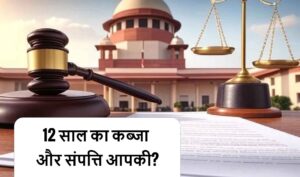
What is Adverse Possession?
Adverse possession is a legal principle under which a person who occupies someone else’s private property without permission for 12 years may claim legal ownership if the original owner fails to take action. This rule is defined under Article 65 of the Limitation Act, 1963.
Key Points:
- Applicable to Private Property: The rule applies only to private immovable property (land, houses). For government land, the possession period is 30 years (Article 112), but it cannot be converted into ownership.
- 12-Year Time Limit: The period is calculated from the date the possessor begins occupying the property.
- Legal Conditions: The possession must be continuous, peaceful, and public.
Limitation Act, 1963: Key Intricacies
The Limitation Act, 1963 aims to ensure that legal claims in civil matters are filed within a specified time frame, preventing old and irrelevant disputes. It maintains the reliability of evidence and streamlines legal processes. Here are the key intricacies related to adverse possession:
- Start of the Limitation Period:
- The limitation period begins from the day the possessor starts occupying the property or when the owner becomes aware of the possession.
- Special Exemptions: If the owner is a minor, mentally incapacitated, or abroad, some relaxation in the limitation period may be granted (Sections 6 and 7).
- Reset Possibility: If the owner takes legal action (e.g., issuing a notice or filing a case) within 12 years, the limitation period may reset.
- Tenants’ Cases:
- Tenants can claim adverse possession only if they prove that their possession was against the owner’s interest, not under a tenancy agreement. Evidence such as rent receipts, electricity bills, or local records is essential.
- The Supreme Court in Darshan Singh v. Gurdev Singh (2020) ruled that tenants must prove they stopped paying rent and claimed ownership.
- Government Property:
- Under Article 112, the limitation period for government land is 30 years, but it cannot be converted into ownership.
- The Supreme Court in Jagpal Singh v. State of Punjab (2011) clarified that illegal possession of government land is never valid.
- Interruption of Limitation Period:
- If the owner initiates legal action within 12 years, the limitation period is interrupted.
- Under Section 14, if a claim is filed in the wrong court and later moved to the correct court, the time spent in the wrong court may be added to the limitation period.
- Burden of Proof:
- The possessor must prove that their possession was continuous, peaceful, and open for 12 years. Documents like electricity bills, water bills, local records, or witness statements are useful.
- The owner must prove they took action within the limitation period.
- Special Circumstances:
- If the property has multiple co-owners, all must be aware of the possession.
- If the possessor makes improvements (e.g., construction) on the property, it may serve as evidence of adverse possession, provided it is against the owner’s interest.
Read More…
- Uttar Pradesh Building Construction and Development By-Laws 2025
- Laws Governing the Sale of Land by Scheduled Caste Landowners to General Category in Uttar Pradesh
- Understanding Section 80 (Section 143) of the Uttar Pradesh Revenue Code, 2006
- Succession Laws in Uttar Pradesh
-
Illegal Land Encroachment? Take These Legal Steps Immediately! (BNSS Update)
- Land Acquisition Act 2013: The Real Story of Farmers’ Rights!

Key Supreme Court Rulings
The Supreme Court has clarified and strengthened the adverse possession rule through several landmark judgments from 2019 to 2025, offering critical guidelines for both owners and possessors.
- Ravinder Kaur Grewal v. Manjit Kaur (2019):
- The Court ruled that the possessor must prove their possession was hostile to the owner and continued uninterrupted for 12 years. The possession must be open and known to the owner.
- Impact: This decision increased the burden of proof on possessors, making claims harder to establish.
- Darshan Singh v. Gurdev Singh (2020):
- The Court clarified that tenants can claim adverse possession only if they prove their possession was separate from the tenancy agreement and against the owner’s interest.
- Impact: Tenants need strong documentary evidence (e.g., electricity bills or local records) to support their claim.
- Jagpal Singh v. State of Punjab (2011):
- The Court ruled that no illegal possession of government land, regardless of duration, can be converted into ownership. The government has the right to reclaim such land.
- 2024-2025 Update: Recent rulings have directed governments to take swift action to remove illegal encroachments and protect their land.
- 2023-2025 Rulings:
- The Supreme Court has emphasized strict enforcement of the Limitation Act. It advised owners to regularly monitor their properties and take timely action against illegal possession.
- The Court also stated that possessors can claim ownership only if they strictly meet all conditions (continuous, peaceful, and open possession).
Conditions for Adverse Possession
Based on the Limitation Act and Supreme Court rulings, the following conditions must be met for adverse possession:
- Continuous Possession: The possession must be uninterrupted for 12 years. Any action by the owner can reset the period.
- Open and Notorious Possession: The possession must be such that the owner knows or should know about it. Secret possession is invalid.
- Peaceful Possession: The possession must be without violence or coercion.
- Hostile Possession: The possessor must prove that their possession was against the owner’s interest.
Precautions for Property Owners
Considering the Limitation Act and Supreme Court rulings, property owners should take the following precautions:
- Regular Monitoring: Periodically inspect vacant land or houses. Drones or local monitoring services can be used.
- Written Agreements: Always sign 11-month tenancy agreements with tenants and renew them regularly.
- Legal Action: Issue a written notice and file a case in court immediately upon discovering illegal possession.
- Documentation: Keep all ownership-related documents (registry, sale deed, electricity bills) safe.
- Local Authorities: Seek help from local police or revenue officials in case of illegal possession.
Precautions for Tenants
Tenants should take the following steps to avoid misuse of the Limitation Act:
- Written Agreements: Always sign a written tenancy agreement with the owner, clearly specifying the rent, duration, and terms.
- Document Preservation: Keep rent receipts, electricity bills, and other documents safe to prove tenancy status.
- Communication with Owner: Maintain regular contact with the owner and resolve disputes promptly.
Rules for Government Land
The Supreme Court has repeatedly clarified that adverse possession does not apply to government land. Under Article 112, the limitation period for government property is 30 years, but it cannot be converted into ownership. In Jagpal Singh v. State of Punjab (2011) and recent 2024-2025 rulings, the Court issued the following directives:
- Illegal possession of government land is unlawful.
- The government must take swift action to reclaim such land.
- Local authorities should actively monitor and remove illegal encroachments.
Social and Legal Implications
The Limitation Act and Supreme Court rulings have significantly influenced property disputes, with the following implications:
- Risk for Owners: Vacant properties face a higher risk of encroachment. Owners must remain proactive.
- Opportunities and Challenges for Tenants: Tenants may claim ownership but must meet stringent conditions.
- Legal Misuse: Some individuals may attempt to misuse this rule, prompting the Court to demand strict evidence.
Conclusion
The adverse possession rule under the Limitation Act, 1963, and the Supreme Court’s recent rulings are critical for both property owners and possessors. This rule allows 12 years of possession to be converted into ownership for private property, provided strict conditions are met. However, it does not apply to government land. The Supreme Court has tightened this rule, urging owners to take timely action to protect their properties.
If you are a property owner, regularly monitor your property and seek legal advice. If you are a tenant, keep your documents and agreements organized. In any property dispute, consult an expert lawyer.
Note: This information is for general awareness. Always consult an expert lawyer before taking legal action in property disputes.
Keywords: limitation act 1963, supreme court judgement on 12 years possession, limitation act, adverse possession limitation act, can a tenant claim ownership of property after 12 years, statute of limitations, जमीन पर कब्जा कब से मान्य है, adverse possession, adverse possession under limitation act, adverse possession meaning, 12 year land rule in india, supreme court judgement on illegal possession of land, limitation period, indian limitation act, supreme court judgement on possession of property, acquisition of ownership by possession under limitation act, adverse possession supreme court judgement, adverse possession section, limitation act, 1963, law of limitation, supreme court judgement on limitation period, law of limitation act, statute of limitations india, what is limitation act, civil procedure code and limitation act, 12 years possession of land, adverse possession against government 30 years, 12 years rent ownership, supreme court 12 years property, limitation act, 1963 supreme court judgement, 12 years tenant rule, law of limitation act 1963, indian limitation act 1963, 12 years possession supreme court, supreme court order on 12 years possession, partition suit not maintainable after lapse of time, adverse possession in limitation act, declaration suit limitation, 12 years adverse possession rule, money recovery suit limitation, 12 year property rule in india, what is the supreme court judgement on possession of property for 12 years, adverse possession time period, creation of ownership by adverse possession under limitation act, partition suit limitation period, limitation act 1963 notes, 12 years land ownership, latest judgement of supreme court on adverse possession, supreme court judgement on adverse possession, उच्चतम न्यायालय का 12 वर्ष का कब्जा के संबंध में लेटेस्ट आदेश pdf, adverse possession 12 years, 12 years tenant supreme court, 12 year tenant rule, land ownership after 12 years, 12 years limitation act, land limitation act, period of limitation under limitation act, supreme court decision possession of land owner, supreme court judgement on property ownership pdf, property case time limit, statute of limitations ontario, limitation for filing partition suit, adverse possession act, limitation for partition suit, limitation act cpc, general rules as to calculation of limitation period, 12 year rule for property, section 27 of limitation act 1963, what is adverse possession, suit for possession limitation, possession of land after 12 years in india, सुप्रीम कोर्ट का बड़ा फैसला 12 साल से ज्यादा जमीन पर कब्जा करने पर होगा मालिकाना हक, limitation act 1963 pdf in telugu, possession of land, limitation act adverse possession, cpc limitation act, limitation act, 1963 notes, adverse possession on government land, adverse possession law, land limitation act 1963, period of limitation, prescribed period under limitation act, 12 year rule land ownership, latest supreme court judgement on adverse possession, possession time, computation of limitation period in cpc, limitation for final decree in partition suit, general principles of limitation act 1963, recovery suit limitation, limitation law, 1963 limitation act, model tenancy act india, adverse possession years, 12 year rule on land ownership, what is limitation act 1963, time limitation, limitation of partition suit, computation of period of limitation under limitation act, after 10 years of renting what happens
ब्लॉग कटेगरी: सम्पत्ति | कानून | वास्तुशास्त्र | संपत्ति कर
[Advertisement]


Exclusive Deals
-

House On Manika Cinema Road Raebareli
₹13,500,000 -

Prime Location Villa Raebareli City
₹13,500,000 -

2 Floor House Ali Mia Colony Raebareli
₹5,500,000 -

Residential Plots Bijnor Lucknow-Kanpur Highway
-

Shop Near Railway Station Raebareli
₹1,200,000 -

3.5 Bigha Agriculture Land Near Bachhrawan Raebareli
-

Residential Plot, Near Pragatipuram Raebareli
-

1.5 Biswa Residential Plot, Ekta Vihar Raebareli
₹7,200,000 -

2000 Sf Commercial Hall In Rana Nagar Raebareli for Rent
-

3 Bigha Agriculture Land Harchandpur 2km
-

4 Acre Factory Raebareli
-

House Near Railway Station
-

Luxury Homestay in Raebareli | AC Rooms | Modular Kitchen | Family & Corporate Stay
-

2.25 Biswa Home Near Manika Cinema Road
₹12,000,000 -
Residential Plots Near Khujauli Chauraha Nagram Road Lucknow
₹1,050,000 -

Commercial Hall For Rent Near Civil Line Raebareli
-

2.35 Biswa Plot On Lalganj Raebareli NH Near Ataura
₹2,900,000 -

1500 sf Duplex Near Tripula
₹6,500,000